
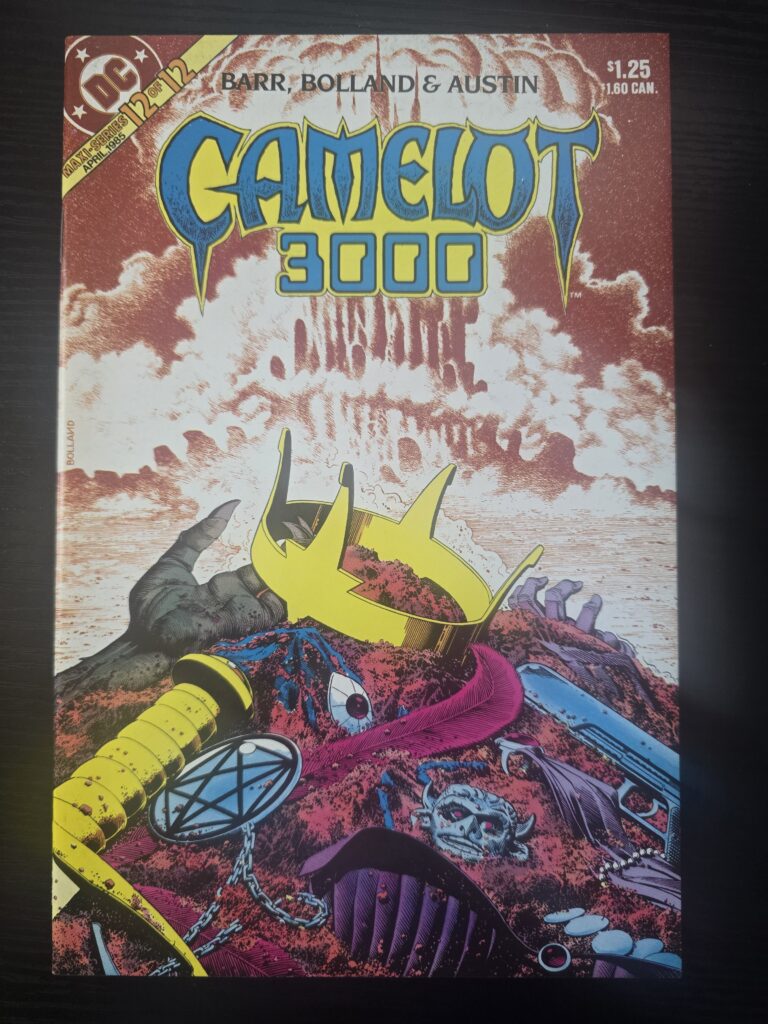
A golden crown sits on a mound of dirt, surrounded by the leftovers of a war: a clawed hand, a pentagram medallion on a chain, a sword hilt, a ray gun, a little demon-faced trinket. Behind it, a giant brown cloud rises over the horizon. Camelot 3000 #12 is the last issue of one of the most important DC books of the 80s, and Brian Bolland’s cover tells you it isn’t going to end quietly.
The basics
- Title: Camelot 3000 #12 (of 12)
- Publisher: DC Comics
- Cover date: April 1985
- Cover price: $1.25 ($1.60 Canada)
- Writer: Mike W. Barr
- Pencils: Brian Bolland
- Cover credit: “Barr, Bolland & Austin” (Terry Austin on inks)
- Colors: Tatjana Wood
King Arthur in the year 3000
The setup is great. According to Wikipedia, an archaeology student named Tom Prentice accidentally wakes King Arthur under Glastonbury Tor in the year 3000, just as the prophecy promised. Earth is under attack by aliens, and four corrupt world leaders are running things.
Arthur frees Merlin from Stonehenge and goes looking for his knights, who have all been reincarnated in the future. Guinevere is a US military commander, Lancelot is a French industrialist, Galahad is a samurai, and Modred is a crooked UN official. Behind the invasion is Morgan le Fay, working from a hidden tenth planet called Chiron.
Why it matters
This book broke a lot of ground for DC. It was the company’s first maxi-series, one of its first books sold only through comic shops, and the first comic series printed on Baxter paper instead of cheap newsprint. That better paper is a big reason copies like this one have held up so well for 40 years.
It also took a risk you didn’t see in mainstream comics in 1982. Sir Tristan comes back in a woman’s body and has to rethink who he is. By the end of the series, Tristan and Isolde are a couple.
It was Bolland’s first major American work, too. He was already known for Judge Dredd in 2000 AD, and his art here is so packed with detail that it slowed the whole series down.
The long wait for #12
The series started out monthly, with the first issue cover-dated December 1982. It didn’t stay that way. The last several issues ran late, and Barr remembered Bolland spending nine months drawing this final issue alone. A twelve-issue monthly ended up stretching across more than two years of cover dates.
How it ends (spoilers)
The knights take the fight to Chiron, and Galahad sacrifices himself to get them into Morgan’s citadel. Arthur sends the others home, forgives Lancelot and Guinevere, then uses Excalibur to set off an explosion that wipes out Morgan and her command center. That’s the cloud on the cover.
The epilogue ties things up and then sets the whole cycle up to start again: on a distant world, an alien pulls Excalibur from a stone.
That cover
Bolland signed it down the left side, and it’s a great finale image. Everything is in brown and white line work except the pile in the front, which pops with yellow, pink, purple and blue. It works like a burial mound for the whole series, with the crown on top. The hand-lettered Camelot 3000 logo, all spiky blue and yellow, is a classic, and the corner box still has the old DC bullet with “Maxi-Series 12 of 12.”
Is it worth anything?
Not much on its own. PriceCharting puts ungraded copies at about $4.50, and most recent eBay sales landed somewhere between a couple of bucks and $10. Graded high-end copies are estimated higher, but there are hardly any tracked graded sales to back that up.
The real value is in the full run. Twelve issues of Bolland art on good paper is a great thing to put together from the bins.
Where to read more
If you’d rather not hunt down all twelve, DC collected the series in a 1997 trade paperback and a Deluxe Edition hardcover in 2008.