
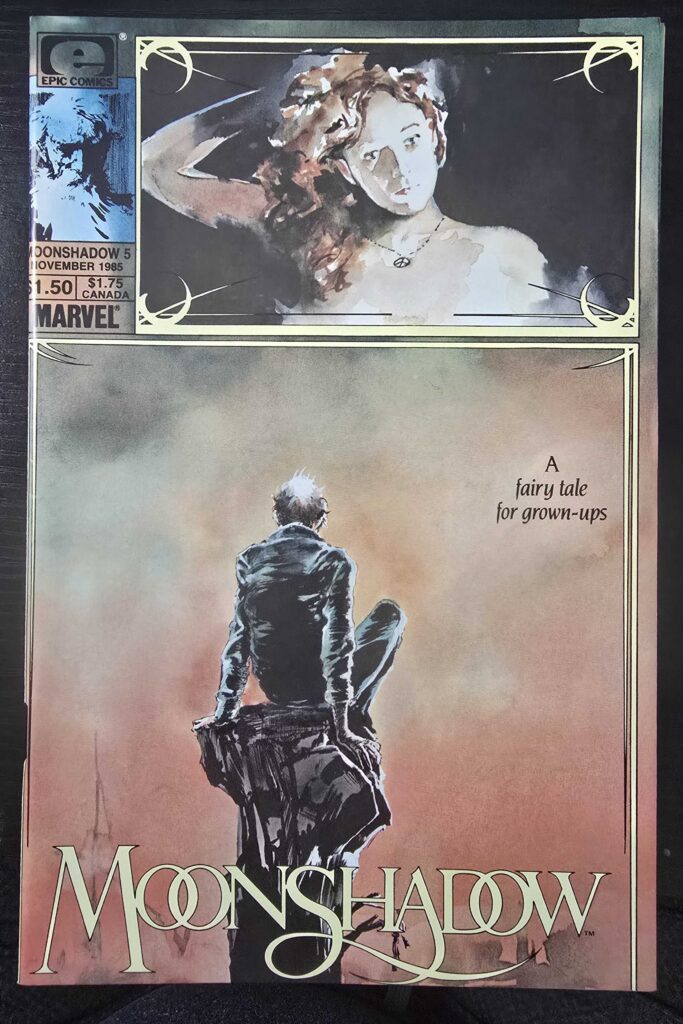
This one came out of a collection I was digging through. Whenever I see one of those Epic Comics books from the 80s, I stop and pull it. Marvel’s Epic line put out some of the strangest and best-looking comics of the decade, and Moonshadow #5 is a good example of why I keep looking.
You can tell from across the room that this isn’t a regular Marvel book. There’s no line art and no flat coloring. The entire cover is watercolor, and so is everything inside.
The basics
- Title: Moonshadow #5 (of a 12-issue maxiseries)
- Publisher: Epic Comics, Marvel’s creator-owned imprint
- Cover date: November 1985
- Cover price: $1.50 ($1.75 Canada)
- Writer: J. M. DeMatteis
- Art: Jon J. Muth
- Letters: Kevin Nowlan
What Moonshadow is about
The cover calls it “a fairy tale for grown-ups,” and that’s a pretty good summary. In 1968 a hippie named Sunflower is abducted from Earth along with her black cat, Frodo. Her captors are the G’l-Doses, godlike aliens that look like glowing balls of light with smirking faces, and they keep her in a kind of cosmic zoo. One of them fathers her son, Moonshadow.
Moonshadow grows up in the zoo. After his mother dies, he heads out into the universe with Ira, a furry, crude, completely self-interested creature who’s basically the id of the whole book. The story is told by Moonshadow at 120 years old, looking back on his younger days. It’s part science fiction, part fantasy and part satire, with plenty of philosophy and poetry mixed in.
A painted comic in 1985
The art is the big story here. Moonshadow is often called the first American comic book done entirely in painted art. That claim gets argued about, since a few earlier books like Silverheels also used painted art, but nothing else on the rack looked like this in 1985. Jon J. Muth was only about 25, and this was his first big comics job. Black Gate’s look back at the series describes his pages as mostly watercolor with some detail drawn over the top.
Muth painted most of the series himself. Kent Williams and George Pratt joined him for the last few issues. Issue #5 comes well before they joined, so the pages here are Muth’s. Kevin Nowlan’s lettering was done on separate overlays so it didn’t touch the paintings, and the lettering style suits the storybook feel of the whole thing.
That cover
The layout is split in two. The top panel is a soft portrait of a red-haired woman wearing a peace-sign necklace, which fits Sunflower, the hippie mom. The bottom is Moonshadow from behind, perched on a dark pillar and staring into a hazy orange sky, with a faint spire off to the left. Thin art nouveau frames with crescent moons in the corners hold it all together, and the logo sits along the bottom in that curvy, interlocking lettering.
It looks more like a storybook cover than a superhero cover, and that’s the point.
Not exactly a kids’ book
“For grown-ups” wasn’t just a tagline. According to Totally Epic’s history of the series, some retailers sent back the very first issue over a single caption, and Marvel ended up making that issue returnable. Later issues came with a content advisory on the cover. By today’s standards it’s pretty tame, but it was a lot for a Marvel-distributed book in 1985.
Is it worth anything?
Not much money. PriceCharting tracks completed eBay sales of this issue, and ungraded copies have recently sold for about $1 to $4. Issue #1 is the one people pay more for. For the middle issues, the value is in reading them. This is a series you want as a full run, and the single issues are an inexpensive way to put one together.
Where Moonshadow went next
Moonshadow has been reprinted more often than most 80s books:
- Marvel collected all 12 issues in 1989, and Graphitti Designs put out a signed, numbered hardcover limited to 1,200 copies.
- DC reprinted the series in 1994 and 1995 as one of the early Vertigo titles.
- DeMatteis and Muth came back in 1997 for Farewell, Moonshadow, a one-shot sequel.
- The Compleat Moonshadow collected everything, and Dark Horse brought it back as a hardcover in 2019. In 2025 Dark Horse released an expanded definitive edition with a new cover and afterword by Muth.
If you see Epic books in a bin or a collection, flip through them. This is a good place to start.