
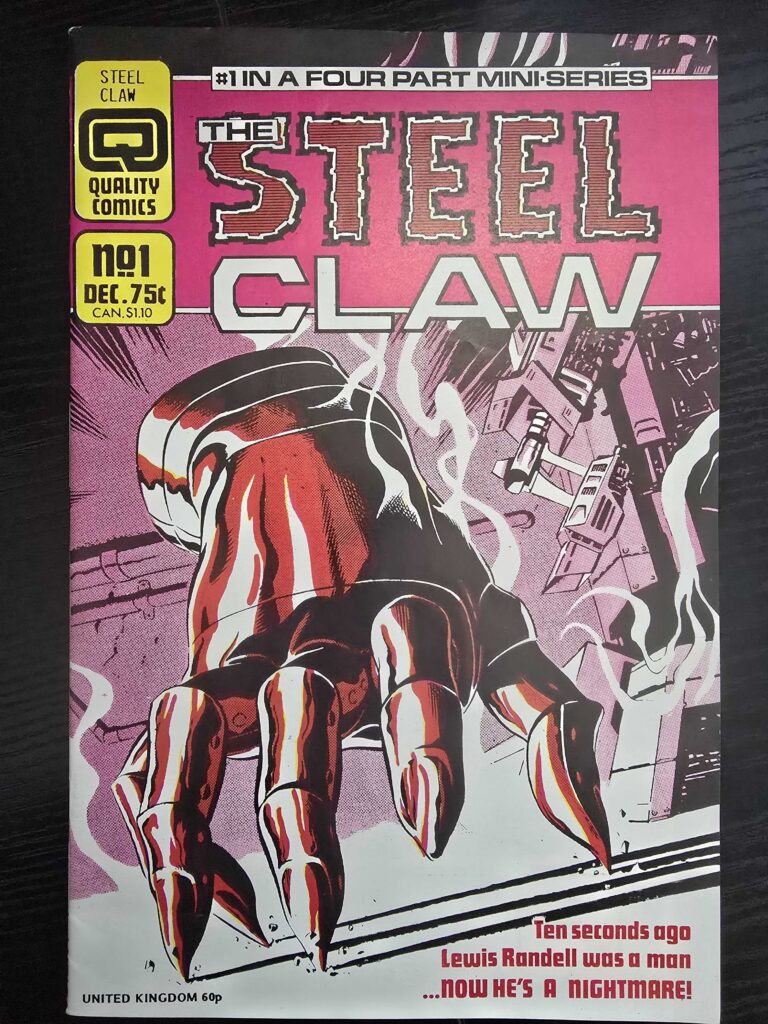
I found The Steel Claw #1 in the dollar bin at The Comic Book Store in Glassboro, NJ, and issues 2 through 4 were sitting right there with it, a buck each. The cover art gave me a 60’s Marvel/Kirby vibe, and I snatched up all four on the spot.
Turns out this isn’t an American comic at all. It’s a 1960s British adventure strip, colored up and repackaged for US comic shops in the mid-80s.
The basics
- Title: The Steel Claw #1 (of a four-issue mini-series)
- Publisher: Quality Comics
- Cover date: December 1986
- Cover price: 75¢ (Canada $1.10, UK 60p)
- Cover art: Garry Leach
- Original strip: Ken Bulmer (writer) and Jesús Blasco (artist), first published in Valiant in 1962
- What I paid: $1
Who is the Steel Claw?
The character’s original name is Louis Crandell, a lab assistant to a scientist named Professor Barringer. He loses his right hand in a lab accident and gets a metal one in its place. A second accident, this time with an experimental ray, leaves him with a strange side effect: a strong electric shock turns him invisible for a while. All of him except the metal hand.
That’s the image the whole strip is built around, and it’s exactly what’s on this cover: a big steel claw creeping across the page with nobody attached to it.
Crandell didn’t start out as a good guy. The accident also left him unhinged for a time, and in the early strips he’s a thief and a villain who uses the invisibility for crime. Later he straightens out and goes to work for a British secret service outfit called the Shadow Squad, and the strip turns into a spy series.
Where it came from
The Steel Claw debuted in the very first issue of Valiant, a British weekly boys’ adventure comic dated 6 October 1962. Ken Bulmer wrote the first three serials with Spanish artist Jesús Blasco on art, then Tom Tully took over the writing. It was one of Valiant‘s most popular strips through the 1960s. It went away in 1970, came back in 1971 as “Return of the Claw,” and ran until 1973.
Why a British strip ended up in an American comic shop
Quality Comics was the US label of Quality Communications, the British company Dez Skinn started in 1982 to publish the anthology magazine Warrior. Around 1986 Quality took over the job of reprinting 2000 AD material for American readers, so the racks filled up with Quality editions of Judge Dredd and other British strips. The Steel Claw went into that mix as a four-issue series running from late 1986 into 1987.
A few things were changed for the US version:
- The old black-and-white Valiant pages were colored.
- The hero’s name was changed. On this cover he’s “Lewis Randell” instead of Louis Crandell.
- Garry Leach drew a new framing story with Randell as an older agent looking back at his criminal past.
That cover
The Kirby vibe is what sold me. The claw fills almost the whole cover, drawn in heavy blacks and hot reds against a pink background, with smoke curling around it and what looks like a dropped gun in the wreckage behind it. The cover line does the rest: “Ten seconds ago Lewis Randell was a man… now he’s a nightmare!”
Is it worth anything?
Not a fortune, but more than a buck. Ungraded copies of this series turn up in online listings for a few dollars each. A CGC-graded 8.5 copy of #1 was listed at $39 on MyComicShop. Those are asking prices, not confirmed sales, so take them as a ballpark. Getting the full four-issue run for $4 felt like a win.
Where the Steel Claw went next
The Quality series didn’t lead to new stories, but the character kept popping back up:
- Grant Morrison used him in Zenith in 2000 AD.
- He’s one of the old British characters in Albion (2005), a six-issue Wildstorm/DC series plotted by Alan Moore and written by Leah Moore and John Reppion.
- Rebellion’s Treasury of British Comics line collected the early Valiant stories in 2021.
If you see these in a bin, grab them. They’re a cheap way into a corner of British comics most American readers never saw.